
Table of Contents
Are you a nurse finishing a twelve-hour shift? Or a runner in the morning after a long weekend mileage day? Perhaps a restaurant manager who has been on the floor since ten? We know you experience a specific kind of tired that lives below the knees. They are heavy, tight, and slow to cooperate when it is time to move again.
At Revive IV Lounge in Buford, GA, we see both of those people walk through the door for the same reason. Our NormaTec® system, built by Hyperice and once reserved for elite athletes, gives tired legs a way to clear out and reset in about the time it takes to answer a few emails.
How does compression therapy speed up recovery?
Compression therapy uses inflatable sleeves that squeeze the legs in a timed sequence, moving pooled blood and fluid up and out of tired muscles. Fresh, oxygen-rich blood then flows back in, which is what most people are feeling when their legs seem lighter afterward.
Why Do Your Legs Feel Heavy After a Long Day or a Hard Session?
Heavy legs usually come down to slowed circulation in the lower body. Your calf muscles act as a second pump, squeezing veins with every step to push blood back toward the heart. That pump stalls in two opposite situations: when it goes barely used, as it does during hours of standing still or sitting at a desk, and when it gets worked so hard that it cannot keep pace with demand.
Either way, blood and lymph fluid settle in the lower legs instead of clearing efficiently. Metabolic byproducts from muscle work linger in the tissue longer than they should. The sensation that follows is remarkably similar across both groups, which is why the office worker and the marathoner describe it in almost identical language: heaviness, tightness, and a sluggish start the next morning.
How Does Compression Therapy Move Fluid the Way Your Muscles Do?
Compression Therapy does the work your calf pump would do if it had the energy left. You slide into sleeves that wrap each leg from foot to hip, and a pneumatic system inflates them in a timed, moving sequence rather than all at once. That movement supports venous return, the mechanics of moving used blood back toward the heart so fresh blood has somewhere to go.
This is where the treatment differs from compression socks. Socks apply steady, unchanging pressure and hold fluid in place reasonably well over a long day. A pneumatic system applies a wave, and a wave moves things. The same rhythmic action also supports natural lymphatic movement, the body’s drainage network for the fluid that sits between cells.
The Three Stages of Compression Therapy: Pulsing, Gradients, and Distal Release
The benefits of compression therapy come from sequencing, not from pressure alone. A tight squeeze alone would simply compress tissue. The NormaTec® system runs three coordinated stages instead:
- Pulsing. Rhythmic waves of compression imitate the contraction of working muscle, pressing fluid out of fatigued tissue and encouraging it to move.
- Gradients. Pressure builds in sequence from the foot upward so fluid keeps traveling in one direction, with far less backflow into the areas already cleared.
- Distal Release. Pressure lifts at the right moment, which allows fresh, oxygenated blood to refill the muscle and deliver what it needs for repair.
Run those three together, and the legs get something close to a full circulation cycle without taking a single step. That is the part a foam roller or a stretch session cannot replicate.
What Does Faster Recovery Look Like?
Most clients describe the change in modest, specific terms rather than dramatic ones. Legs feel lighter. Calves feel less tight. Ankles feel less puffy than they did walking in. As a leg recovery treatment, this reads as a reset rather than a transformation, and that honest framing is worth setting up front.
The more common report is about the following morning. People who use muscle recovery therapy regularly often mention easier movement the next day and less next-day stiffness after a hard session or a long shift. Results vary based on training load, hydration, sleep, and overall health.
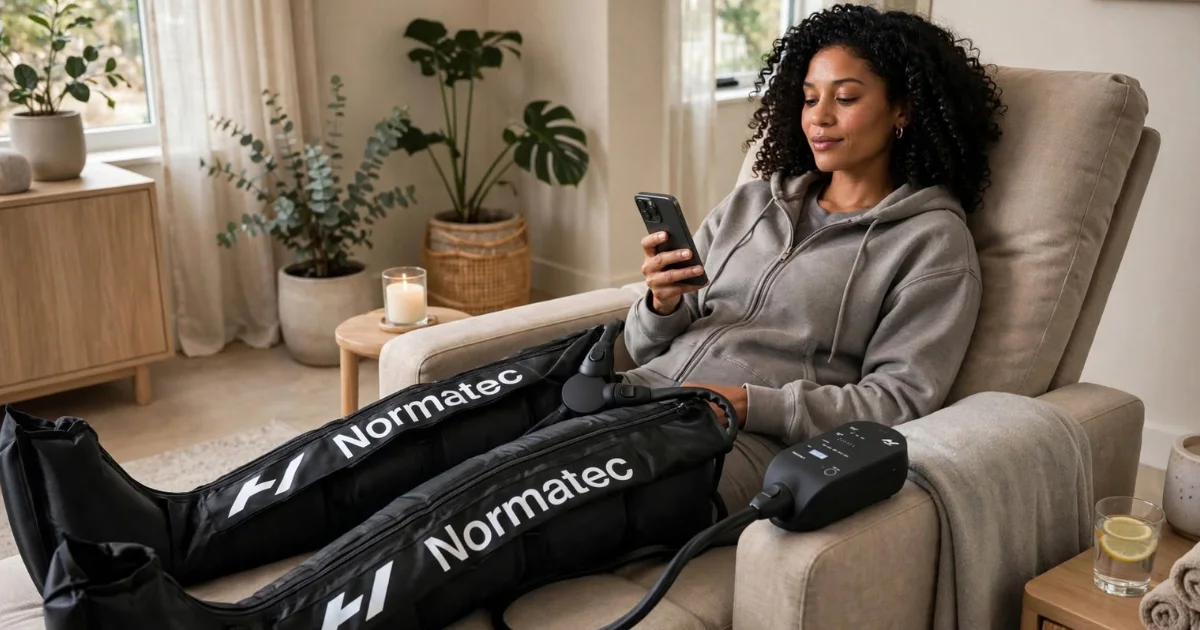
A session typically runs 20 to 30 minutes. You sit back in a lounge chair, the sleeves do their work, and most people read, scroll, or close their eyes. Compression supports good recovery habits; it doesn’t replace rest, hydration, or sensible training.
Compression Therapy for Athletes vs. Compression Therapy for Long Workdays
Compression Therapy for athletes is usually scheduled around training:
- After a hard session, to help legs clear out before the next one
- Between back-to-back training days when fatigue starts stacking up
- Through a heavy training block, as regular maintenance rather than a one-off
Occupational use follows the calendar instead:
- After a long shift on your feet, which describes most nurses, teachers, stylists, and hospitality staff across Gwinnett County
- On a scheduled weekly basis for people whose jobs keep them standing or sitting for hours
- Before a travel day or an event that means extended time upright
You do not need to train for anything to benefit here. Plenty of people booking Recovery Therapy Buford appointments have not run a mile in years. Their legs still work hard, and the fatigue they carry responds to circulation support the same way an athlete’s does.
Who Compression Therapy Suits, and Who Should Check With a Provider First
Compression Therapy in Buford, GA suits most healthy adults dealing with routine muscle fatigue, leg heaviness, or general swelling after long hours upright. It also pairs naturally with the other energy recovery treatments we offer, including IV hydration for clients who arrive depleted after training or a demanding week.
Some conditions call for medical clearance before your first session:
- A history of blood clots or deep vein thrombosis
- Peripheral artery disease or known circulation disorders
- Uncontrolled heart failure
- Active infection, open wounds, or a skin condition on the legs
- A recent fracture or unhealed injury in the lower body
- Pregnancy
Pressure is adjustable, and a session should feel firm and rhythmic, never painful. If anything on that list applies to you, or if you are unsure how compression fits with a condition you are managing, talk with your physician and let our team know before we begin.
Give Your Legs a Reset Before the Next Long Day
You don’t have to push through tired legs until the weekend. A short session in the sleeves gives your circulation the assist it has been missing, and most clients tell us they notice it most the following morning.
Our team in Buford is happy to walk you through what a first appointment involves and help you figure out where compression fits in your week. Recover Faster and Feel Refreshed—Book Your Compression Therapy Session in Buford Today.